
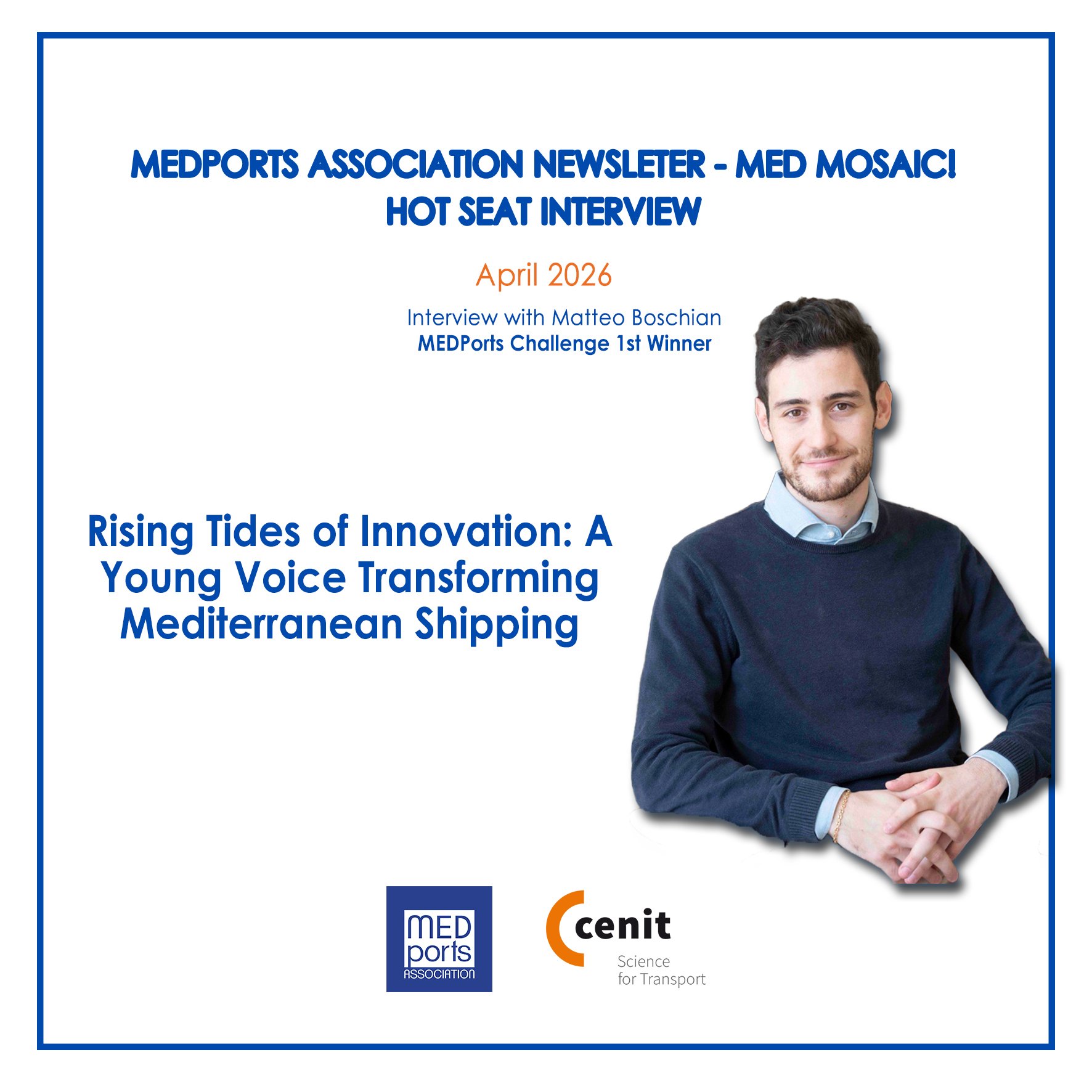
Hot Seat Interview with Matteo Boschian, Researcher and PhD candidate in Mobility and Sustainable Transport at CENIT and 1st MEDPorts Challenge Winner
1.As the winner of the 3rd edition of the MEDPorts Challenge competition, how would you describe the impact this achievement has had on you, both personally and professionally.
First of all, I would like to thank the MEDPorts Association for organizing this initiative, which I believe is an excellent way to bring young people closer to the maritime sector. I would also like to acknowledge all the participants.
On a personal level, this achievement is particularly meaningful, as it was my third attempt at the challenge. This year’s main topic, Short Sea Shipping, was closely aligned with my area of expertise in intermodal transport, which allowed me to perform at my best. From a professional perspective, winning the MEDPorts Challenge represents an important milestone. Participating in the next MEDPorts Forum will be a valuable opportunity to expand my network and engage with the member ports of the association.
2. Could you share an overview of your professional journey and explain what led you to participate in the MEDPorts Challenge?
After completing my studies at the Politecnico di Milano, where I obtained a Master’s degree in Mobility Engineering, I moved to Barcelona to begin a PhD at the Universitat Politècnica de Catalunya (UPC), while also working at CENIT, a research center for innovation in transport where maritime transport is one of the key areas of expertise.
During my PhD, I have been involved in several research projects related to the maritime sector, including port governance, port services, and intermodal transport, with a focus on sustainable freight transport in the port sector. Through this work, I established connections with the Port of Barcelona, which is how I first learned about the MEDchallenge and what motivated me to participate
3. From your perspective, how do you see the future of the maritime sector and Mediterranean ports, particularly in terms of innovation and sustainability?
I consider myself fortunate to be a young researcher in the maritime sector at such a pivotal moment. The industry is undergoing profound transformation as it responds to global disruptions and accelerates the adoption of innovative technologies to drive the energy transition. With transport remaining a major contributor to greenhouse gas emissions, decarbonization is no longer optional but an urgent priority. This context makes the present moment particularly stimulating for the development of new ideas and solutions.
The Mediterranean Sea has historically been a key basin for international trade, generating significant economic and social value for the surrounding regions. Today, it continues to hold a strong strategic position at the global level. In this context, many Mediterranean ports are actively investing in innovative solutions to support decarbonization, such as Onshore Power Supply (OPS) and alternative fuel bunkering, while the region also offers significant potential for renewable energy production.
At the same time, Short Sea Shipping connections between ports play a crucial role in advancing sustainability by reducing reliance on road transport and mitigating its associated externalities
If Mediterranean ports are able to strategically leverage these opportunities, they will be well positioned to further strengthen their role and global relevance within the maritime sector.